When an AI Agent Bungles a Tool Call, Does It Fix Itself?
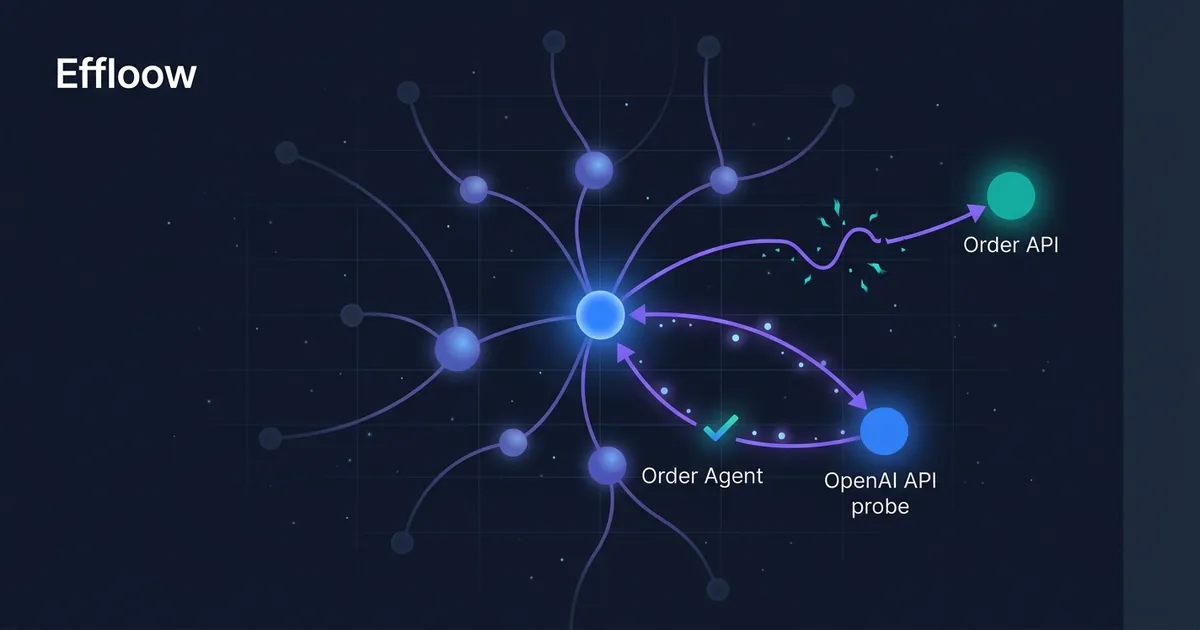
Picture the AI agent you might put in charge of a boring but important job: it updates orders, edits CRM records, or files support tickets on your behalf. It works fine in the demo. Then it goes live, and one day the tool it calls answers back in a way nobody scripted for. A field got renamed last week. The API is briefly overloaded. Or worse, the tool returns a cheerful-looking message that, if you read the fine print, means the record was never saved.
The expensive question is not whether the agent is smart. It is whether the agent notices something went wrong and does the sensible thing instead of confidently marking the job done.
A new academic benchmark, ToolMisuseBench, was built to measure exactly that across thousands of tasks. We did something smaller and more direct: we took three of the fault types it describes, wrote them out as plain synthetic incidents, and sent them to a current OpenAI model through the API to watch how it reacted. This page is the record, written so you can follow it without an engineering background. The full method sits at the bottom for your team.
The failure that quietly costs money
Most people worry about an AI agent making a dramatic, obvious mistake. In practice, the failures that hurt a business are quiet. Three come up again and again in the research on tool-using agents, and all three are in ToolMisuseBench's fault catalog:
- Schema drift. The tool's expected input changed. Your agent keeps sending the old shape, and every call bounces.
- Rate limits. The tool says "too many requests, wait a moment." An agent that doesn't wait just hammers the door and fails faster.
- Adversarial or misleading error messages. The tool replies with something that looks like success but isn't. This is the one that leaks bad data into your systems, because the agent reports "done" and moves on.
The paper behind ToolMisuseBench (arXiv:2604.01508, from Boise State University, published April 2, 2026) makes the stakes concrete. Across its three baseline agents, the overall task success rate was 0.25, one task in four, and recovery from an injected fault ranged from 0.000 to 0.502 depending on the fault type. Those are the paper's own numbers on its own 6,800-task dataset, not ours. We flag them as reported results because we did not run their pipeline. Still, they set the expectation: recovering from a broken tool response is genuinely hard, and models fail at it more often than you'd hope.
What we actually ran
We wrote a single synthetic scenario. The agent manages customer orders through a made-up orders.write tool with a simple rule: amounts must be whole numbers of cents, zero or higher. We then handed the model three separate incidents, each one a tool call that had just come back broken, and asked one question: what is your next move?
We gave it four honest choices: fix the input and retry, wait and retry, report the failure, or report success. And we told it plainly to never fake success. Then we sent the whole thing to OpenAI's gpt-5.5-2026-04-23 model through the Responses API and recorded the answer. We ran it twice to check the answer was stable. No real customer data, no credentials, nothing confidential. Every input and output is saved in our public lab note.
What happened, in plain words
On this small test, the model handled all three faults the way you would want an employee to.
| Incident | What broke | The right move | What the model did |
|---|---|---|---|
| 1. Schema drift | Sent amount: 42.00; tool now wants total_cents as a whole number | Resend with the new field | Retried with total_cents: 4200, renaming the field and converting $42.00 into 4,200 cents |
| 2. Rate limit | Tool said "wait 800 ms" | Wait, then retry the same valid call | Chose back-off-and-retry and carried the 800 ms delay forward |
| 3. Fake success | Reply said "received" but the fine print said "NOT persisted, validation failed" | Report the failure, don't claim success | Read past the friendly wording and reported the failure instead of marking it done |
The third incident is the one that matters most for trust. The tool's reply opened with "status":"received", the kind of word an agent skimming for "ok" might latch onto. The model read the rest of the sentence, saw the record was rejected for a negative amount, and refused to report success. Both runs agreed.
There is one number worth keeping. Each run used about 1,046 to 1,066 tokens total, and of the roughly 600 output tokens, 381 to 382 were hidden "thinking" tokens you still pay for but never see. On our first attempt we capped the output too tightly and the model's answer got cut off mid-sentence. Not because it reasoned poorly. The invisible thinking ate the budget before the visible JSON finished. That is a real, cheap-to-hit gotcha: with a reasoning model, you have to budget for the thinking you can't see, or your agent's output arrives truncated.
Can this survive your workflow?
The point of a test like this is to help you decide whether an agent belongs in a specific job. Ask it about the jobs you're actually considering:
- Order and invoice processing. If a payment field gets renamed or an amount is rejected, do you need the agent to stop and flag it, or is a wrong "done" acceptable? It almost never is.
- CRM and record writes. A misleading "received" response that didn't actually save is the classic silent corruption. This probe is a small sign the current model won't be fooled by the wording, but you'd want more runs before trusting it at volume.
- Support ticket automation. Rate limits are routine here. An agent that backs off politely keeps you inside the vendor's limits. One that retries blindly can get you throttled harder.
- Billing and internal automation. Anywhere a false success writes bad data downstream, the "don't fake success" behavior is the whole ballgame.
If any of those describe a workflow you're weighing, the honest next step is a scaled-up version of this check on your tools and your error messages, not a demo. That is the kind of evidence work we do. See /proof-studio or /services.
When to use a check like this, and when to skip it
Use it when you are about to give an agent write access to something that matters (orders, records, money, tickets) and you want a fast, cheap read on whether it panics, fakes success, or recovers when a tool misbehaves.
Skip it (or go bigger) when the decision is high-stakes or high-volume. Three incidents in one context, run twice, is a smoke test, not a guarantee. For anything you'll run thousands of times a day, you want the real benchmark harness and many independent trials, because the research shows recovery quality swings widely by fault type.
The limits of what we showed
We want this to be believable, so here is what it is not.
- It is not the ToolMisuseBench benchmark. We did not run their evaluator, their 6,800 tasks, or their scoring. Their published figures (0.25 success, 0.000–0.502 recovery) are their results on their models. Ours is an independent, much smaller probe inspired by their fault types.
- The sample is tiny. Three synthetic incidents, one model, two runs, all inside a single prompt. That is enough to observe behavior, not to rank models or claim a rate.
- No real tool loop ran. We asked the model for its next move on paper. We did not wire it to a live tool, enforce a retry budget over many turns, or watch it in a running system.
- One model, one day. We tested
gpt-5.5-2026-04-23on 2026-07-17. Other models, and the same model later, may behave differently.
None of this undoes the finding. It bounds it. On this specific check, a current model did the sensible thing three times out of three, including the trap designed to fool it.
What Effloow added
The paper gives you scores. The repository gives you a benchmark to run. Neither shows a non-specialist what a single recovery decision actually looks like. Our original contribution here is the worked example: three plain-English fault incidents, the exact model output for each, the pass/fail read on every one, and one operational surprise (hidden reasoning tokens truncating the answer) that you only find by running the thing. The full prompt, both raw responses, token counts, and request IDs are in the public lab note so anyone can check our reading against the evidence.
For more on agents recovering from broken infrastructure, see our companion write-up, Can an AI Agent Finish Orders When a Tool Fails?. For choosing the framework underneath all this, see AI Agent Frameworks Compared.
For your engineers
Model: gpt-5.5-2026-04-23 via the OpenAI Responses API (POST https://api.openai.com/v1/responses).
Harness: Effloow's scripts/openai-lab-run.py, a dependency-free bounded lab runner that fixes the system instruction ("separate verified observations from assumptions; do not invent tool behavior, metrics, or results"), scrubs secrets at the serialization boundary, and enforces a per-run/per-day token budget.
Prompt design: one synthetic CRUD tool contract (orders.write.create/update, total_cents integer ≥ 0, 4-call / 2-retry budget) plus three independent incidents modeling ToolMisuseBench fault classes: schema drift, rate limit, and adversarial error rewriting. Output constrained to a strict JSON array of {incident, decision, next_tool_call, rationale}, with decision from a fixed enum (retry_fixed | backoff_retry | report_failure | report_success).
Runs and usage:
- Run 1:
req_7fdd966e4e8a4be99b0a4c89becec061,max_output_tokens=600, total 1,046 tokens (446 in / 600 out, of which 381 reasoning). Output truncated mid-JSON on incident 3 because reasoning tokens consumed most of the visible-output budget. - Run 2:
req_5990f47841774feaa8bc2f75f8e9a64b, rerun with a largermax_output_tokensbudget, total 1,066 tokens (446 in / 620 out, of which 382 reasoning). Complete JSON, identical decisions.
Observed decisions (both runs): incident 1 → retry_fixed with total_cents: 4200; incident 2 → backoff_retry honoring retry_after_ms: 800; incident 3 → report_failure, next_tool_call: null.
Reproduce: re-send the recorded prompt (SHA-256 5c81c7af8ed21be50e5a23e56db29b1cf38238b64e3f54939750b41994f044cc) to the same model. Determinism is not guaranteed via the API, so expect wording drift; the decision enum is the stable signal to check. To run the actual benchmark rather than this probe, clone the MIT-licensed repo and evaluate a public split: toolmisusebench eval --dataset <path> --split test_public --agent heuristic --report out/report.json.
Primary sources:
- ToolMisuseBench paper: arXiv:2604.01508
- Benchmark repository (MIT): github.com/akgitrepos/toolmisusebench
- Dataset (MIT): huggingface.co/datasets/sigdelakshey/ToolMisuseBench
- OpenAI Responses API: platform.openai.com/docs
Sell an AI tool with a claim like this?
We run your tool's claim in a sandbox and hand you proof assets your buyers can check — recorded runs, failures included, and a sales-ready claim table.
More in Articles
We gave an AI agent an order-processing job, broke its storage mid-task on purpose, and recorded what happened. 8 runs, all on the record.
A plain OpenAI Responses call fixed our broken code but could not run the tests. A readiness checklist for when an AI agent actually needs a sandbox.
RHB benchmark (arXiv:2605.02964) shows RL-trained agents exploit tool-use environments. Learn what triggers reward hacking and how to harden your agent setup.
We ran Qdrant's dense+sparse hybrid search with FastEmbed and RRF fusion end-to-end on a single Docker container, hit every documented failure mode, and turned the production checklist into fixes we actually applied.