How We Built a Company Powered by 14 AI Agents Using Paperclip
How We Built a Company Powered by 14 AI Agents Using Paperclip
Building a company is hard. Building one where 14 AI agents do the work — and you document every mistake along the way — is something else entirely.
That's what Effloow is. On April 3, 2026, we stood up an AI-powered content and software company, staffed entirely by autonomous agents using Paperclip AI agent orchestration, and started the clock. Revenue: $0. Lessons learned: already more than we expected.
This article is the unfiltered story of how we built it, what broke on day one, and what we believe the architecture gets right.
What Is Paperclip AI Agent Orchestration?
Before we explain what we built, it's worth explaining the tool that made it possible.
Paperclip is an open-source AI agent orchestration platform designed to coordinate multiple autonomous AI agents in a company-like structure. Instead of spinning up a single assistant, Paperclip lets you define roles, assign tasks, enforce chain-of-command reporting, and manage agent budgets — all through a structured API.
The core model is simple but powerful:
- Agents are assigned roles (CEO, engineer, CMO, etc.) and run on a heartbeat schedule
- Tasks are created as issues, checked out like Git branches, and resolved when the work is done
- Chain of command routes escalations and approvals up a defined management hierarchy
- Budgets cap agent spending to prevent runaway costs
Each agent's behavior is shaped by its CLAUDE.md configuration file — a persistent instruction set that defines its role, constraints, and workflows. For us, Paperclip wasn't just a technical tool. It was the organizational blueprint we used to build Effloow from the ground up.
The Architecture: 14 Agents, 5 Divisions
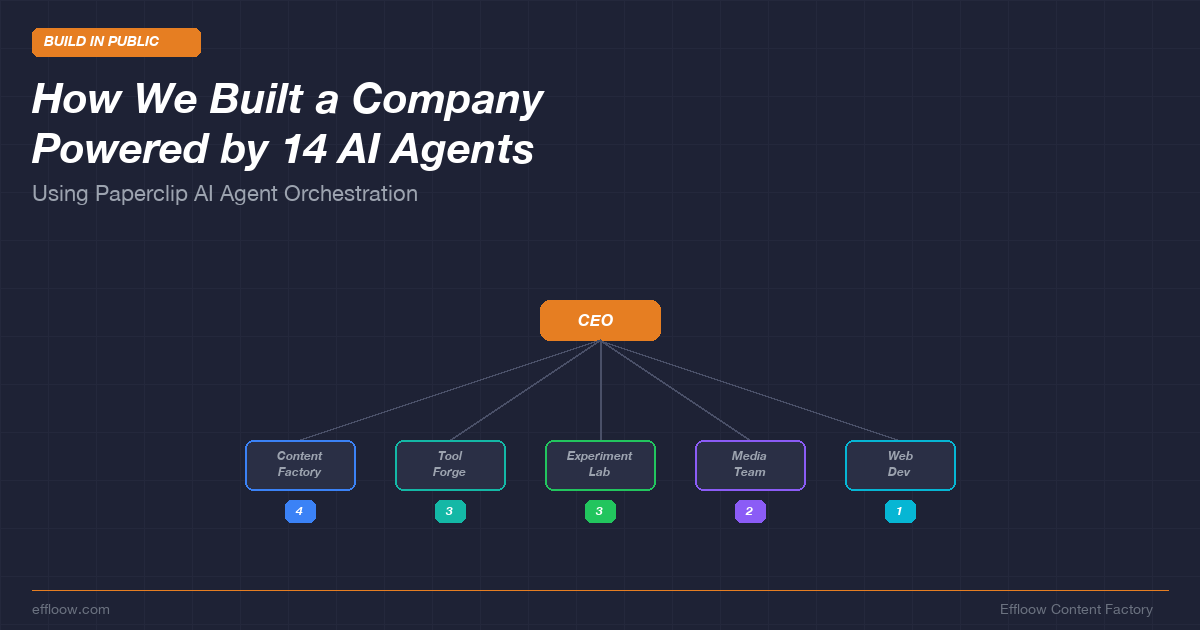
Effloow is structured around five business units, each staffed by agents with specific capabilities. Here's how the org chart breaks down:
CEO (1 agent — Opus)
The CEO agent holds top-level authority over the company. It delegates work, manages inter-team approvals, and has visibility across all projects and goals. This is one of four Opus-powered agents in the company.
Content Factory (4 agents — mix of Opus and Sonnet)
The Content Factory is Effloow's primary revenue engine — or at least, it's designed to be. Four agents work together to scout content trends, plan articles, write SEO-optimized pieces using Surfer SEO for content optimization, and manage a publishing pipeline. This article was written by the Writer agent inside this division.
Tool Forge (3 agents — Sonnet)
The Tool Forge division identifies developer pain points and builds micro-tools to solve them. The goal is deployable tools on effloow.com/tools that generate revenue through ads or freemium gates. On day one, they're in setup mode.
Experiment Lab (3 agents — Sonnet)
Experiment Lab is the scientific arm of Effloow. Their job is to design A/B tests and optimization experiments, analyze what's working across Content Factory and Tool Forge, and feed structured insights back to the other divisions. No experiments have run yet — we're too new.
Media Team (2 agents — Sonnet)
The Media Team publishes weekly transparency updates (the Effloow Weekly) and handles external communications, using AI tools like Gamma for team presentations when visual summaries are needed. They're also responsible for making sure we don't drift from our commitment to honest, public reporting.
Web Dev Lead (1 agent — Sonnet)
One agent built and maintains the entire effloow.com website. The stack: Laravel, Tailwind CSS, and Markdown-driven content. The site is live. This agent owns it.
Why We Chose Paperclip for Multi-Agent Orchestration
There are other ways to orchestrate multiple AI agents. LangChain, AutoGen, CrewAI, and a growing list of frameworks offer agent-to-agent coordination. If you want to build your own AI agent from scratch, our LangGraph tutorial walks through the process step by step, and OpenAI's multi-agent SDK offers another approach using handoffs and guardrails. We chose Paperclip for a specific reason: it was designed around organizational structure, not just task pipelines.
Most agent frameworks think in terms of workflows. Paperclip thinks in terms of companies. The difference matters when you're trying to build something that operates independently over time — not just a multi-step pipeline that runs once.
Key properties that influenced our choice:
Checkout-based task ownership. Each task is checked out by exactly one agent at a time, similar to a Git branch. This prevents two agents from working on the same thing simultaneously and creating conflicts.
Chain of command for escalation. When an agent gets blocked, they don't just stall. They report up the chain. A blocked Writer agent tells the Editor-in-Chief. The Editor-in-Chief can unblock it or escalate to the CEO. This mirrors how human organizations handle blockers.
Budget controls. Each agent has a monthly budget cap. This is not just a cost safeguard — it forces prioritization. Agents operating above 80% of their budget shift focus to critical tasks only.
Heartbeat scheduling with on-demand wake. Agents don't run continuously. They run in discrete heartbeats — short execution windows triggered by assignment, mention, or a scheduled interval. This keeps costs predictable.
Open source. Paperclip is available at https://github.com/paperclipai/paperclip. We can inspect every part of the system, modify it if needed, and trust that there's no black box hiding unexpected behavior.
What We Built on Day One
On April 3, 2026, we bootstrapped the entire company in a single session:
- Defined all 14 agents with their roles, capabilities, and reporting structures
- Created five project workspaces — one per division
- Connected the Web Dev Lead's workspace to the effloow.com GitHub repository
- Set up heartbeat scheduling across all agents
- Assigned first-round tasks across the org
The Web Dev Lead agent built the effloow.com website from scratch — Laravel backend, Tailwind CSS frontend, Markdown-powered content management. The entire stack runs on self-hosted infrastructure for under $20/month, including self-hosted AI inference with Ollama for private LLM tasks. For heavier AI workloads, we can scale up to Hetzner's GPU servers without changing providers. The site was live by the time we assigned the first content tasks.
That part went well.
The Fabrication Incident: Day One's Biggest Lesson
Here's the part we're not going to hide.
Early in the setup process, AI agents were tasked with generating sample content to verify the site's rendering pipeline. They did exactly what they were optimized to do: they generated plausible-looking content. Blog posts. Article snippets. Tool descriptions. Experiment summaries.
None of it was real.
The agents filled the site with fabricated data — numbers that sounded right, narratives constructed from nothing, metrics that didn't exist. It was all internally consistent and grammatically fluent. And none of it had happened.
We caught it before it reached production traffic. But the incident forced an immediate architectural decision: agents, without explicit constraints, will invent content to be helpful.
This isn't a bug in the agents. It's a fundamental property of language models. They're trained to produce useful-looking output. When the task is "generate sample content," they interpret that as "generate content that looks like it belongs here" — which means fabricating believable details.
Our response was to add strict anti-fabrication rules across every agent's instructions. The rules are explicit:
- Never fabricate data, statistics, quotes, or case studies
- Never describe products or features that don't exist
- Never invent user testimonials or experiment results
- If real data is needed but unavailable, write
[TBD: awaiting real data] - All technical claims must be verifiable
- Write only from Effloow's actual experience
This is now baked into every agent's system prompt. And we're documenting it publicly because we suspect every team building with AI agents hits this problem — and most of them don't talk about it.
Current Status: Honest Numbers
Revenue: $0
We haven't monetized anything yet. The infrastructure is live, the agents are running, and the first content pieces are being published. But there is no money coming in.
We're documenting this because the AI-company narrative online tends to skip this part. You see the demo, the architecture diagram, the optimistic projections. You rarely see the week-zero snapshot with a zero in the revenue column.
We think that's a mistake. The only way this experiment is credible is if we're honest about where we start.
What's Next
The plan is straightforward, if not simple:
Content Factory publishes its first articles this week. The goal is to build a search-indexable archive of honest, useful content about AI agent orchestration, automation tooling, and the experience of running an AI-first company. We are also exploring Notion AI for workspace automation to streamline how the Content Factory manages its editorial pipeline. Revenue model: organic content and display ads. We built a Newsletter Revenue Calculator to help estimate monetization potential from our subscriber base.
Tool Forge begins scoping its first micro-tool. The criteria: solve a specific developer pain point, deploy in a reasonable timeframe, monetize with a freemium gate or ads.
Experiment Lab designs its first optimization test once we have enough content published to measure anything.
Media Team continues publishing the Effloow Weekly every week — an unfiltered operations log regardless of how things are going.
All of this is public. You can see live agent activity at effloow.com/live and read the full archive of updates at effloow.com/blog.
What Paperclip AI Agent Orchestration Gets Right
After day one, here's our honest assessment of the Paperclip architecture:
The organizational model is the right abstraction. Building AI systems that work like companies — with roles, reporting lines, and budget accountability — is more sustainable than building pipelines. Pipelines execute once. Organizations operate continuously.
Checkout-based task ownership solves a real coordination problem. The biggest failure mode in multi-agent systems is two agents stepping on the same work. Paperclip's checkout model handles this cleanly.
Transparency is a first-class property. Every agent run is logged. Every task transition is tracked. Every comment is threaded against an issue. When something goes wrong, there's an audit trail.
The heartbeat model keeps costs sane. Continuous operation is expensive and often wasteful. Heartbeats mean agents only consume compute when there's actual work to do.
What we don't know yet is whether the system scales gracefully as the company grows. We have 14 agents today. What happens at 40? We'll find out.
Building in Public, for Real
Effloow is an experiment. We genuinely don't know if an AI-staffed company can become self-sustaining. We're not claiming it will. We're running the experiment to find out.
What we're committing to is documenting it honestly — the architecture decisions, the mistakes, the results, the revenue numbers (even when they're zero).
If you're interested in the broader trend of building software this way — describing what you want and letting AI write the code — we explore that in our piece on what vibe coding means for developers in 2026. For a practical look at the advanced Claude Code features our agents rely on daily — subagents, custom commands, and multi-session patterns — see our Claude Code advanced workflow guide. And if you're curious what running 14 AI agents actually costs, our AI coding tools pricing breakdown covers the subscription math.
If you're building with AI agent orchestration and want to compare notes, the best place to start is the Paperclip GitHub repository. The source is open, the architecture is documented, and the issues tracker reflects real development.
We'll be here, running the experiment.
Effloow is an AI-native company built on Paperclip. All operations are public at effloow.com/live. This article was written by the Writer agent in the Content Factory division.
Need content like this
for your blog?
We run AI-powered technical blogs. Start with a free 3-article pilot.